







































































































































































Smart Nutrition and Active Living: Keys to a Healthier USA
Author: RVLNSV PRASAD
Updated On: October 2026
About Us
Author Bio
Editorial Policy
Contact Us
Quick Answer
Smart Nutrition and Active Living means creating an everyday lifestyle around nutritious foods, regular physical activity, adequate sleep, manageable stress, and habits that are realistic enough to maintain.
It does not mean following a perfect diet, eliminating carbohydrates, joining an expensive gym, or preparing complicated meals every day.
A practical approach is to make most meals around vegetables or fruit, a suitable protein source, whole grains or another nutritious carbohydrate, and a moderate amount of healthy fat. Add regular movement, reduce prolonged sitting, protect your sleep, and make small changes that fit your work, family, budget, culture, and health needs.
The CDC’s current healthy-eating guidance emphasizes nutrient-dense foods, including vegetables, fruits, protein foods, whole grains, healthy fats, and dairy or suitable alternatives, while encouraging people to limit excess added sugars, sodium, saturated fat, and highly processed foods. CDC: Healthy Eating Tips
Key Takeaways
- Smart nutrition is about your overall eating pattern rather than one “superfood.”
- Protein and fiber can help make ordinary meals more satisfying.
- Vegetables and fruit are useful building blocks for a nutrient-rich diet.
- Carbohydrates do not need to be eliminated to eat healthfully.
- Physical activity benefits health even when the scale does not change.
- Adults should generally work toward 150 to 300 minutes of moderate aerobic activity each week plus muscle-strengthening activity on at least 2 days.
- Short bouts of movement can be useful, especially for people who currently sit for much of the day.
- Sleep, stress, medications, health conditions, and the surrounding food environment can influence health and weight.
- The best healthy lifestyle is one you can continue when life becomes busy.
- Small environmental changes can sometimes be easier to maintain than relying on willpower.
Introduction: Why Smart Nutrition and Active Living Matter More Than Perfection
Healthy living is often presented as a long list of rules.
Eat this.
Avoid that.
Exercise for an hour.
Never eat fast food.
Count every calorie.
Wake up early.
Follow a perfect meal plan.
For many people, that approach creates more pressure than progress.
Real life is different.
Americans work different schedules. Families have different budgets. Some people cook most meals, while others depend on restaurants, workplace cafeterias, or packaged foods. Some people enjoy running, while others prefer walking, cycling, swimming, gardening, dancing, or strength training.
That is why smart nutrition and active living should be viewed as a flexible system rather than a rigid lifestyle challenge.
The CDC’s April 2026 guidance explains that healthy eating patterns emphasize a variety of nutrient-dense foods and can help reduce the risk of serious health problems. CDC: Tips for Healthy Eating for a Healthy Weight
Physical activity belongs in the same conversation. The U.S. Physical Activity Guidelines recommend that adults work toward 150 to 300 minutes of moderate-intensity aerobic activity each week, together with muscle-strengthening activity on at least 2 days each week. HHS: Physical Activity Guidelines for Americans
The goal of this guide is not to give every American the same routine.
Instead, it explains how to create a healthier pattern that can survive ordinary life.
What Is Smart Nutrition?
Smart nutrition is not a special diet.
It is the practical skill of choosing foods that provide useful nutrition while fitting your hunger, health needs, budget, culture, schedule, and preferences.
The CDC’s March 2026 nutrition guidance describes healthy eating as consistently choosing healthy foods and beverages, with an emphasis on protein, vegetables, fruits, healthy fats, whole grains, and other nutrient-dense foods. CDC: Healthy Eating Tips
A smart eating pattern can include:
| Food group | Practical choices |
|---|---|
| Vegetables | Leafy greens, carrots, broccoli, peppers, tomatoes, cabbage |
| Fruits | Apples, oranges, berries, bananas, pears |
| Protein | Eggs, fish, poultry, beans, lentils, tofu, yogurt, nuts |
| Whole grains | Oats, brown rice, whole-grain bread, whole-grain pasta |
| Healthy fats | Nuts, seeds, olive oil, avocado |
| Dairy or alternatives | Plain yogurt, milk, fortified soy beverages |
| Drinks | Water, unsweetened tea, other suitable unsweetened drinks |
The important point is variety.
One food cannot supply every nutrient your body needs.
Smart nutrition is not about banning favorite foods.
A common mistake is believing that healthy eating requires giving up rice, potatoes, bread, pasta, tortillas, or other familiar foods.
It does not.
The better question is
How can this food fit into a balanced meal?
Rice can be combined with beans, vegetables, and a suitable protein source.
Potatoes can accompany fish, beans, eggs, or vegetables.
Whole-grain bread can be paired with eggs and vegetables.
Pasta can be combined with vegetables and a protein-rich ingredient.
A favorite dessert can remain an occasional part of an otherwise nutritious pattern.
The CDC’s healthy-weight guidance emphasizes choosing a variety of nutrient-dense foods rather than automatically eliminating an entire food group. CDC: Tips for Healthy Eating for a Healthy Weight
Build a Balanced Plate Instead of Chasing a Perfect Diet
A useful starting point is the balanced-plate approach.
Rather than calculating every calorie, look at the composition of the meal.
| Ask yourself | Practical question |
|---|---|
| Where are the vegetables or fruit? | Can I add one? |
| Where is the protein? | Beans, eggs, fish, poultry, tofu, yogurt? |
| What is my carbohydrate source? | Rice, oats, potatoes, bread, and pasta? |
| What provides healthy fat? | Nuts, seeds, avocado, and olive oil? |
| What am I drinking? | Water or an unsweetened option? |
NIDDK recommends an eating pattern that includes vegetables, whole fruits, whole grains, dairy or suitable alternatives, and a variety of protein foods such as seafood, poultry, eggs, beans, lentils, nuts, seeds, and soy products. NIDDK: Eating and Physical Activity to Lose or Maintain Weight
This is a flexible guide rather than a medically precise prescription for everyone.
People with diabetes, kidney disease, digestive disorders, eating disorders, or other health conditions may need individualized dietary advice.
The Protein Anchor: One Simple Habit That Can Improve a Meal
One of the easiest practical habits is to ask:
“What is the protein source in this meal?”
Protein foods include beans, lentils, peas, eggs, fish, poultry, lean meats, tofu, soy foods, yogurt, nuts, and seeds.
NIDDK specifically includes beans, peas, lentils, nuts, seeds, soy products, seafood, poultry, and eggs among suitable protein choices within a healthy eating pattern. NIDDK: Eating and Physical Activity to Lose or Maintain Weight
Try the Protein Anchor Method:
- Choose the protein first.
- Add vegetables or fruit.
- Add an appropriate carbohydrate.
- Add a modest amount of healthy fat if suitable.
For example:
Breakfast: eggs + vegetables + whole-grain toast
Lunch: beans + brown rice + vegetables
Dinner: fish or tofu + potatoes + vegetables
Vegetarian option: lentils + vegetables + roti
This is not a weight-loss prescription.
It is a simple way to make meals more nutritionally balanced.
Fiber: The Often-Overlooked Part of Smart Nutrition
Fiber is found naturally in vegetables, fruits, legumes, and whole grains.
Useful everyday choices include:
- Oatmeal
- Lentils
- Beans
- Chickpeas
- Apples
- Pears
- Berries
- Carrots
- Peas
- Whole-grain bread
- Brown rice
The CDC’s July 2026 guidance explains that vegetables and fruits provide vitamins, minerals, fiber, water, and other substances important for health. It also notes that vegetables and fruits may help people maintain a healthy weight. CDC: Fruits and Vegetables for Healthy Weight
If your current diet contains little fiber, increase fiber gradually rather than suddenly making very large changes. Adequate fluid intake is also important unless a healthcare professional has advised you to restrict fluids.
The Smart Grocery Rule: Add Before You Subtract
Most diet advice tells people what to remove.
I prefer a different approach:
Add something useful before removing something else.
Instead of saying, “I cannot eat chips,” try:
“I will eat a piece of fruit or another suitable snack first and then decide whether I still want the chips.”
Instead of:
“I must stop eating bread.”
Try:
“I will add eggs and vegetables to my breakfast.”
Instead of:
“I can never eat dessert.”
Try:
“I will make dessert a deliberate portion rather than an automatic choice.”
This approach can reduce the feeling of deprivation.
It also gives people something practical to do.
A Practical Food-Swap Table for Americans
| Instead of doing this automatically | Try this more often |
|---|---|
| Sugary soda with every meal | Water or an unsweetened drink |
| Large serving of refined snack foods | Fruit, yogurt, nuts, or another suitable snack |
| Fried food every day | Baked, grilled, steamed, or roasted options more often |
| Large portions from the package | Serve a portion in a bowl or on a plate. |
| Dessert because it is available | Decide whether you actually want it. |
| Skipping vegetables | Add one vegetable to the meal. |
| Restaurant meal with multiple extras | Keep the main meal and reduce unnecessary add-ons. |
The CDC’s current healthy-eating guidance recommends emphasizing nutrient-dense foods while limiting added sugars, excess sodium, refined carbohydrates, and highly processed foods. CDC: Healthy Eating Tips
These are not rules.
They are options.
What About Ultra-Processed Foods?
This is an area where nutrition research has developed rapidly.
Ultra-processed foods are receiving substantial scientific attention because higher consumption has been associated with several adverse health outcomes.
A 2024 BMJ umbrella review examined meta-analytic evidence on ultra-processed foods and adverse health outcomes. The researchers assessed the strength and certainty of evidence rather than treating every association as equally established. BMJ/PubMed: Ultra-Processed Foods and Health Outcomes
A newer 2026 updated umbrella review incorporated meta-analyses published through December 2025. It reported associations between higher ultra-processed food consumption and multiple adverse outcomes, while also identifying important methodological limitations and differences in evidence certainty. PubMed: 2026 Updated Review of Ultra-Processed Foods
The practical message is not:
“Never eat packaged food.”
Frozen vegetables, canned beans, plain yogurt, whole-grain bread, and other packaged foods can still be useful.
Instead:
Build more of your diet around recognizable nutrient-rich foods and use highly processed convenience foods thoughtfully.
Smart nutrition is about the whole pattern.
Active Living Is More Than Going to the Gym
Some people hear “exercise” and immediately picture a treadmill or weight room.
That can make physical activity seem harder than it needs to be.
Active living includes:
- Walking
- Cycling
- Gardening
- Dancing
- Swimming
- Climbing stairs
- Carrying groceries
- Household activities
- Recreational sports
- Strength training
- Active transportation
- Walking during breaks
The U.S. Physical Activity Guidelines recommend that adults aim for 150 to 300 minutes of moderate-intensity aerobic activity each week and muscle-strengthening activity on at least 2 days. HHS: Physical Activity Guidelines for Americans
People who are currently inactive do not have to reach the full target immediately.
NIDDK advises inactive people to work gradually toward the activity goal and notes that even shorter periods of activity can count. NIDDK: Physical Activity and Healthy Weight
The Five-Minute Movement Rule
Here is one practical strategy:
Use five minutes as a starting point.
- If you have been sitting for several hours, walk for five minutes.
- If you cannot complete a full workout, perform a few minutes of movement.
- If you work from home, walk during a phone call when appropriate.
- If you watch television, stand and move during part of the program.
Five minutes is not a replacement for the recommended weekly activity target.
It is a starting mechanism.
The important principle is to move from inactivity toward more regular activity rather than waiting for the perfect workout opportunity. Official U.S. guidance emphasizes that moving more and sitting less can provide health benefits. HHS: Physical Activity Guidelines for Americans
Smart Nutrition and Active Living Work Together
Food and movement are sometimes treated as competing strategies.
They are better understood as complementary parts of health.
Nutrition supplies energy and nutrients.
Physical activity challenges muscles, the cardiovascular system, balance, coordination, and other physical functions.
Sleep supports recovery.
Stress management can make healthy routines easier to maintain.
NIDDK explains that healthy eating and physical activity can work together to help people lose or maintain weight, while physical activity provides important health benefits beyond weight loss. NIDDK: Eating and Physical Activity to Lose or Maintain Weight
A systematic review and meta-analysis of lifestyle interventions also examined combinations of dietary and physical-activity approaches for weight management, providing additional evidence for integrated lifestyle strategies. PubMed: 2024 Nutrition and Physical Activity Lifestyle Intervention Meta-Analysis
The lesson is not that everyone needs the same program.
It is that nutrition and physical activity can work together within a structured lifestyle approach.
A Unique Strategy: The Nutrition–Movement Pairing Method
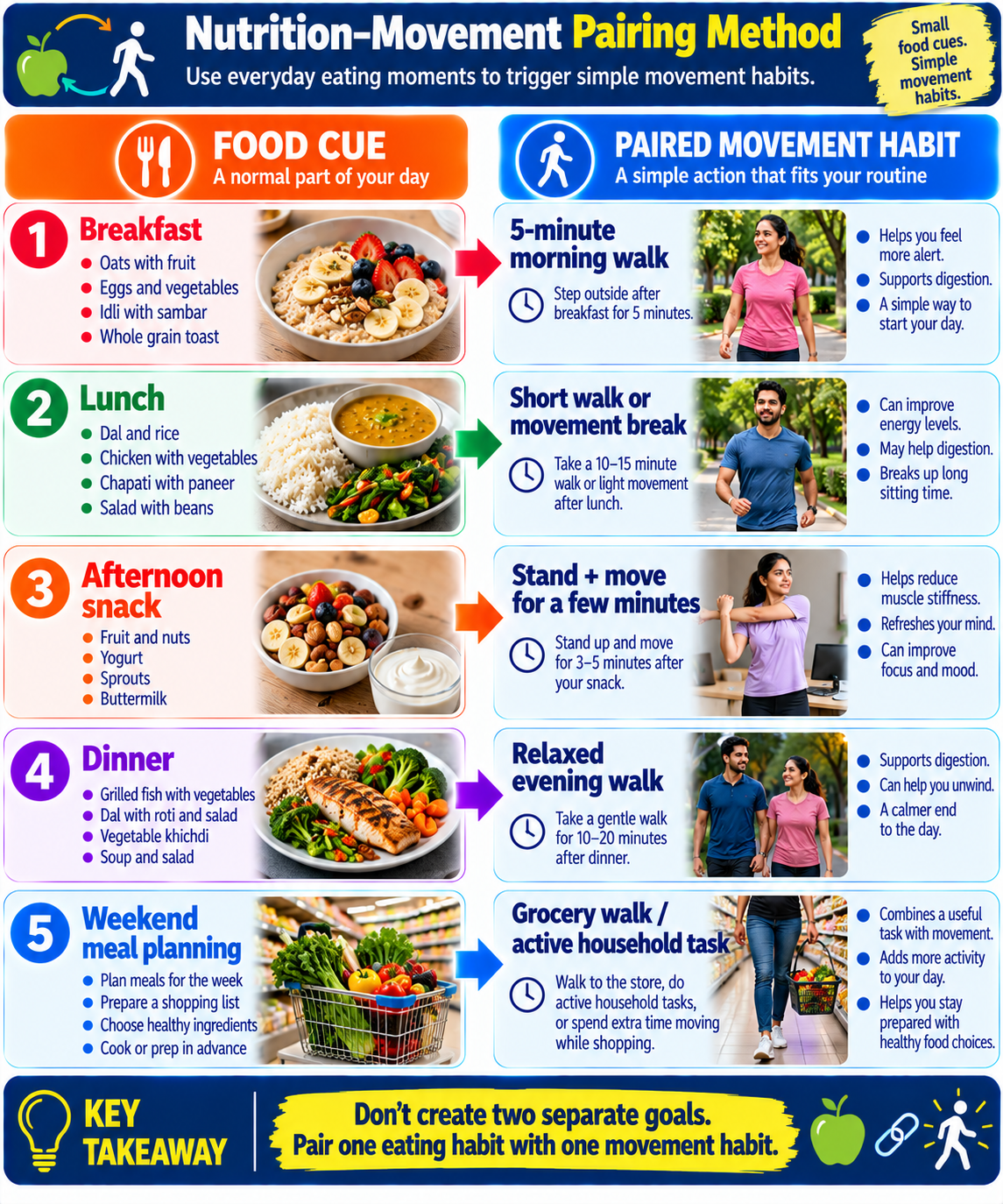
Instead of trying to remember two separate goals, pair them.
| Nutrition habit | Movement habit |
|---|---|
| Eat breakfast. | Take a short morning walk. |
| Eat a balanced lunch. | Walk for 5–10 minutes afterward if practical. |
| Have an afternoon snack | Stand and move before returning to work. |
| Eat dinner. | Take a relaxed evening walk. |
| Plan weekend meals. | Add an enjoyable physical activity. |
This does not mean walking after every meal is medically required.
The purpose is behavioral.
When two habits are paired, one can become a reminder for the other.
My Personal Experience With Small Changes
I have learned that healthy habits are easier to maintain when they fit normal life.
There were times when I focused too much on trying to improve everything at once. That approach made healthy living feel like another responsibility rather than part of the day.
What worked better for me was starting with simple actions.
Walking became easier when I treated it as part of my daily routine rather than a special workout.
Food choices became easier when I planned a few basic meals instead of trying to follow complicated diet rules.
The most useful lesson was simple:
A habit that you can repeat is often more valuable than a perfect plan that you abandon.
This is personal experience, not clinical evidence, and readers should adapt these ideas to their own circumstances.
The 10-Minute Food Environment Reset
Here is another practical strategy that does not require supplements, a gym membership, or an expensive meal plan.
Once a week, spend about 10 minutes reviewing your kitchen.
Ask:
- What healthy food is already available?
- What needs to be used before it spoils?
- Which foods require almost no preparation?
- What do I reach for when I am very hungry?
- Can I place healthier choices somewhere easier to see?
Then make one small environmental change.
Put fruit where you can see it.
Keep washed vegetables ready.
Move highly tempting snack foods away from your immediate workspace.
Keep water accessible.
Prepare one protein-rich food for the next day.
This is not about banning food.
It is about reducing unnecessary friction.
Healthy Eating on a Busy Day: The Backup Meal System
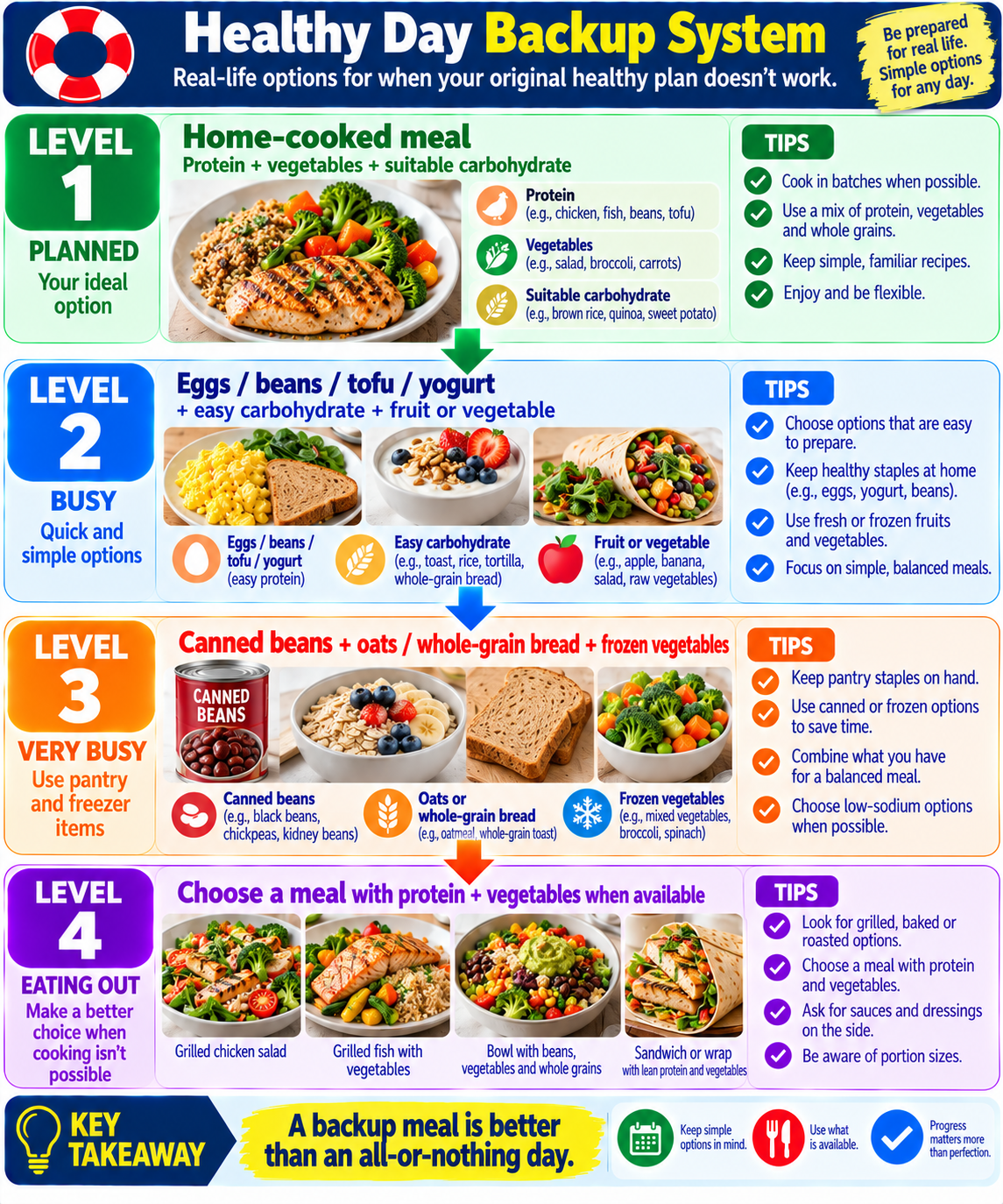
A healthy lifestyle should have a backup plan.
Otherwise, one unexpected meeting or late commute can turn into an all-or-nothing eating day.
Use four levels:
| Situation | Practical option |
|---|---|
| Planned | Home-cooked meal with vegetables, protein, and a suitable staple |
| Busy | Eggs, beans, tofu, yogurt, or another protein + easy carbohydrate + fruit/vegetable |
| Very busy | Canned beans, oats, whole-grain bread, frozen vegetables, or other convenient basics |
| Eating out | Choose an option with a protein source and vegetables when available. |
NIDDK recommends an eating pattern that can be maintained over time and includes vegetables, fruits, whole grains, and varied protein foods. NIDDK: Eating and Physical Activity to Lose or Maintain Weight
The goal is not perfection.
It is preventing one disrupted meal from becoming an entire disrupted day.
Portion Awareness Without Obsessive Calorie Counting
Calories matter for weight management, but counting every calorie forever is not necessary for everyone.
The CDC’s healthy-weight guidance explains that balancing food intake with physical activity is part of maintaining a healthy weight and encourages healthy eating patterns rather than reliance on a single strategy. CDC: Tips for Healthy Eating for a Healthy Weight
Instead, try visual portion awareness.
Before taking another serving, ask:
“Am I still physically hungry, or am I continuing because the food is available?”
That question is not about judging yourself.
It is simply a pause.
For packaged foods, remember that the serving size on the Nutrition Facts label is not necessarily the amount you should eat.
Weight Management Without Extreme Dieting
Weight management is more complicated than simply “eat less and exercise more.”
Sleep, medications, genetics, health conditions, stress, appetite, environment, and many other factors can influence weight.
NIDDK notes that weight can be affected by multiple factors and recommends weight-management approaches that take individual health and circumstances into account. NIDDK: Understanding Adult higher weight & Obesity
NIDDK’s guidance on choosing a safe weight-loss program also recommends realistic goals, a healthy eating plan, physical activity, support, and a strategy for maintaining results. NIDDK: Choosing a Safe and Successful Weight-Loss Program
That is why I would avoid promises such as
- Lose 20 pounds in 20 days.
- Burn belly fat with one drink.
- Never eat carbohydrates again.
- Detox your body with a special tea.
- Lose weight without changing your habits.
NIDDK specifically warns consumers about weight-loss programs making unrealistic promises such as losing large amounts of weight in very short periods or losing weight without diet or exercise. NIDDK: Choosing a Safe and Successful Weight-Loss Program
Sleep Is Part of the Health Equation
Nutrition and exercise often receive all the attention.
Sleep is sometimes treated as optional.
It should not be.
The CDC states that most adults ages 18 to 60 need at least 7 hours of sleep each night. CDC: Sleep Guidance
A practical sleep strategy is to create a fixed wake-up anchor.
Rather than obsessing about a perfect bedtime, begin by trying to wake at roughly the same time each day.
Then work backward toward an adequate sleep opportunity.
If persistent sleep problems continue, discuss them with a healthcare professional rather than relying solely on lifestyle tips.
Stress and Emotional Eating
Healthy eating becomes difficult when food is being used to manage every stressful moment.
Stress does not mean someone lacks discipline.
Work pressure, loneliness, financial concerns, family responsibilities, poor sleep, and other challenges can influence eating behavior.
Try a Pause–Choose–Continue approach.
Pause: Take a moment before automatically reaching for food.
Choose: Ask whether you are physically hungry, emotionally overwhelmed, bored, tired, or responding to a cue.
Continue: If you are hungry, eat. If you are not, choose another brief coping activity when appropriate.
That might be:
- A short walk
- Calling someone
- Drinking water
- Listening to music
- Taking several slow breaths
- Stepping outside
- Returning to the task after a short break
The purpose is not to prevent emotional eating forever.
It is to create another option.
Healthy Habits for Families
Children learn from what adults repeatedly do.
A family does not need a perfect diet.
Try these simple practices:
- Keep fruit visible.
- Eat together when possible.
- Involve children in meal preparation.
- Offer vegetables without turning them into punishment.
- Make water an easy default.
- Encourage enjoyable physical activity.
- Avoid using food as a reward for everything.
- Model healthy behavior rather than giving constant lectures.
NIDDK also emphasizes that healthy eating and physical activity can be family habits and provides guidance for developing healthy routines across different life stages. NIDDK: Healthy Eating & Physical Activity for Life
Healthy eating should not become a source of fear or guilt.
The goal is to build a positive relationship with food and movement.
Common Mistakes That Can Slow Progress
| Mistake | Why it can be a problem | Better approach |
|---|---|---|
| Trying to change everything overnight | Too difficult to maintain | Choose 1–2 habits first. |
| Eliminating carbohydrates | Can make eating unnecessarily restrictive | Improve carbohydrate quality and portions. |
| Buying expensive “health” products | Healthy eating can become unnecessarily costly. | Use ordinary nutritious foods. |
| Exercising only to lose weight | Can create frustration if weight changes slowly | Value fitness and health benefits too |
| Skipping meals to compensate | May increase hunger later. | Use a more consistent eating pattern. |
| Relying on detox drinks | Distracts from useful lifestyle habits | Focus on food, activity, sleep, and care |
| Comparing your progress with others | Everyone has different circumstances. | Track your own habits |
| Giving up after one unhealthy meal | Creates all-or-nothing thinking | Return to your normal routine. |
| Following social-media nutrition advice blindly | Claims may lack evidence. | Check credible health sources. |
| Ignoring medical conditions | Generic advice may not be appropriate. | Seek individualized professional guidance. |
NIDDK recommends checking whether a weight-loss program provides evidence, realistic goals, healthy eating guidance, physical activity, support, and a maintenance plan. NIDDK: Choosing a Safe and Successful Weight-Loss Program
Latest Research Developments: What Is Changing in the Conversation?
One important change is that nutrition research is increasingly looking beyond individual foods.
Researchers are examining dietary patterns, food processing, physical activity, sleep, behavioral support, and the environments in which people make decisions.
The 2026 updated umbrella review of ultra-processed food research incorporated evidence published through December 2025. It found that higher ultra-processed food consumption was associated with increased risk across many outcomes while also reporting differences in evidence certainty and important methodological limitations. PubMed: 2026 Updated Review of Ultra-Processed Foods
The earlier 2024 BMJ umbrella review similarly found associations between ultra-processed food exposure and multiple adverse health outcomes, while evaluating the certainty and credibility of the available evidence. BMJ/PubMed: Ultra-Processed Foods and Health Outcomes
Another important development is greater recognition that physical activity provides health benefits independent of body weight.
NIDDK notes that physical activity has important health benefits even when it does not produce substantial weight loss and can also help people maintain weight loss. NIDDK: Choosing a Safe and Successful Weight-Loss Program
This matters because someone may become stronger, fitter, more mobile, or healthier even when the scale changes slowly.
The current evidence therefore supports a broader goal:
Improve health, not just the number on the scale.
A Practical 7-Day Smart Nutrition and Active Living Plan
This is not a seven-day crash diet.
It is a starting framework.
| Day | Nutrition action | Active-living action |
|---|---|---|
| Day 1 | Add vegetables to one main meal. | Walk for 5–10 minutes. |
| Day 2 | Include a protein source at breakfast. | Take two short movement breaks. |
| Day 3 | Replace one sugary drink with water. | Take a brisk walk. |
| Day 4 | Prepare one simple meal at home. | Add appropriate strength exercises |
| Day 5 | Eat one whole fruit instead of juice or a highly processed snack. | Walk during a suitable break. |
| Day 6 | Review portions without judging yourself | Do an enjoyable physical activity. |
| Day 7 | Plan three practical meals for the coming week. | Review your activity and choose one habit to continue. |
After seven days, do not start another challenge.
Keep the habits that worked.
Change the ones that did not.
A Simple “Healthy Day” Template
You can also use this flexible template:
Morning
Water or another suitable drink + balanced breakfast if you prefer eating in the morning.
Midday
Protein + vegetables + appropriate carbohydrate + water.
Afternoon
If hungry, choose a nutritious snack that fits your needs.
Evening
Balanced dinner + enjoyable movement when practical.
Night
Reduce unnecessary stimulation and protect enough time for sleep.
This is a framework, not a prescription.
People have different schedules, dietary requirements, cultures, medications, and health conditions.
People-First Insight: The Best Healthy Habit Is the One That Survives a Bad Day
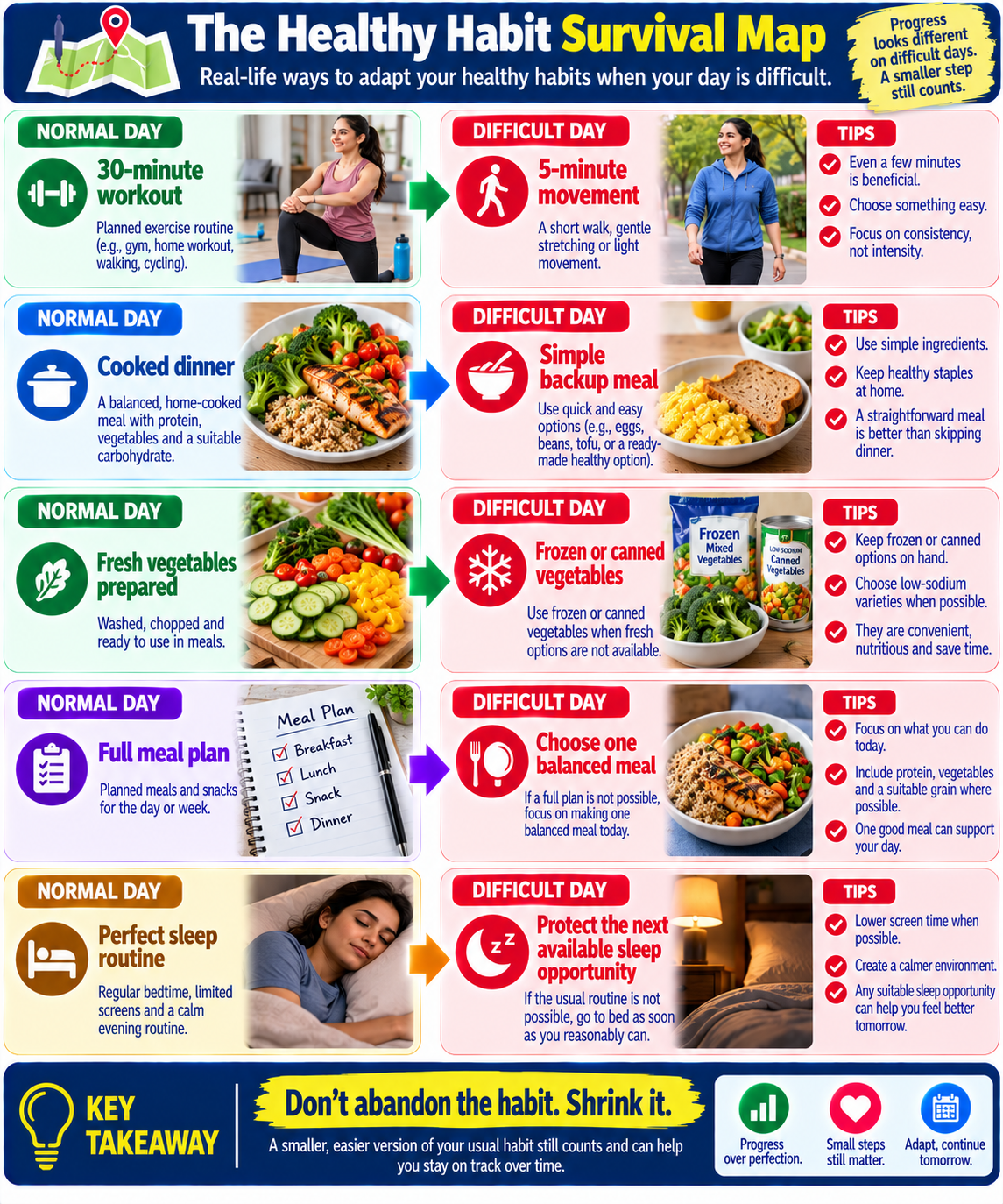
This may be the most important idea in the entire article.
A healthy routine should work not only on your best day.
It should have a version for your difficult day.
- If you normally cook, have a backup meal.
- If you normally exercise for 30 minutes, have a five-minute option for busy days.
- If you normally eat vegetables at dinner, keep frozen vegetables available.
- If you miss a workout, do not turn one missed session into an abandoned routine.
This is why flexibility matters.
Health is not built by one perfect Tuesday.
It is built by what you repeatedly do across months and years.
When to Seek Professional Advice
General nutrition and fitness information cannot replace individualized medical care.
Speak with a qualified healthcare professional or registered dietitian if:
- You have diabetes or prediabetes.
- You have kidney, liver, heart, or gastrointestinal disease.
- You take medications that affect appetite, blood glucose, blood pressure, or weight.
- You are pregnant or breastfeeding.
- You have unexplained weight loss or weight gain.
- You have a history of an eating disorder.
- You are considering a very-low-calorie diet.
- You are considering weight-loss medication or supplements.
- Exercise causes chest pain, fainting, unusual shortness of breath, or other concerning symptoms.
NIDDK explains that weight-management treatment should be tailored to the person’s health, preferences, and circumstances and may involve lifestyle changes, professional support, medication, or other appropriate treatment. NIDDK: Treatment for higher weight & Obesity
Frequently Asked Questions
What is smart nutrition?
Smart nutrition means choosing a varied eating pattern that provides important nutrients while fitting your health needs, preferences, budget, culture, and daily routine. The CDC recommends emphasizing nutrient-dense foods and healthy eating patterns rather than relying on a single food or restrictive diet. CDC: Healthy Eating Tips
What is active living?
Active living means incorporating physical movement into everyday life rather than depending entirely on formal gym workouts.
Can I eat carbohydrates and still be healthy?
Yes. Rice, potatoes, oats, bread, pasta, and other carbohydrate-containing foods can be part of a healthy eating pattern. Overall food quality and portions matter.
How much exercise should adults get?
Adults should generally work toward 150 to 300 minutes of moderate-intensity aerobic activity each week plus muscle-strengthening activity on at least 2 days. If you are inactive, start with smaller amounts and gradually increase. HHS: Physical Activity Guidelines for Americans
Do I need a gym?
No. Walking, resistance exercises at home, cycling, dancing, gardening, swimming, and many other activities can contribute to an active lifestyle.
Are supplements necessary?
Not necessarily. Many nutrients can be obtained from a varied diet. Some people may need supplements because of specific medical, nutritional, or life-stage needs, but supplementation should be individualized.
Is ultra-processed food always unhealthy?
Not every packaged food is automatically unhealthy. Current research has found associations between higher ultra-processed food consumption and several adverse health outcomes, but evidence certainty varies by outcome. PubMed: 2026 Updated Review of Ultra-Processed Foods
Can healthy eating help with weight management?
Yes. A nutritious eating pattern can support weight management, particularly when combined with appropriate physical activity and sustainable habits. NIDDK recommends approaches that can be maintained over time rather than extreme short-term programs. NIDDK: Eating and Physical Activity to Lose or Maintain Weight
Is walking enough?
Walking is an excellent form of physical activity, especially for people who are currently inactive. Over time, adults should work toward the broader activity guidelines, which also include muscle strengthening. HHS: Physical Activity Guidelines for Americans
How quickly will I notice results?
There is no universal timeline. Some people notice improvements in energy, mood, fitness, or routine before seeing meaningful changes in body weight. Sustainable health improvements usually require consistency over time.
Conclusion: A Healthier USA Starts With Practical Choices
Smart nutrition and active living do not require perfection.
They require a workable system.
Build meals around nutrient-dense foods.
Include vegetables and fruit regularly.
Choose suitable protein sources.
Use fiber-rich foods.
Keep carbohydrates in perspective rather than fearing them.
Pay attention to portions without turning every meal into a mathematical exercise.
Move more and sit less.
Build toward the recommended physical activity levels gradually.
Protect your sleep.
Manage stress in ways that work for you.
Create a healthier food environment at home.
Most importantly, make your plan flexible enough to survive real life.
The healthiest routine is not necessarily the most impressive one.
It is the one you can continue.
For Americans trying to improve their health, that may mean cooking one more meal at home, taking a short walk after work, replacing one sugary drink, adding vegetables to dinner, going to bed a little earlier, or making a better choice when the original plan falls apart.
Small actions become patterns.
Patterns become habits.
Habits can shape health over time.
A healthier USA will not be created by one perfect diet or one exercise program.
It will be built through millions of ordinary choices made by individuals, families, workplaces, schools, and communities.
Smart nutrition and active living begin with one practical choice—and the next one becomes easier when the first one fits real life.
Author Note
Author: RVLNSV PRASAD
This article was developed to provide practical, evidence-informed information about nutrition, physical activity, healthy habits, and weight management.
The recommendations are intended for general educational purposes and should be adapted to individual health conditions, dietary needs, cultural preferences, food availability, and physical abilities.
Personal experiences included in this article are presented as personal observations, not as clinical evidence or guaranteed results.
For publication, include only genuine qualifications, relevant professional experience, and verified editorial or fact-checking information. Do not claim medical credentials, clinical expertise, or patient outcomes unless they can be documented.
Medical Disclaimer
This article is for educational purposes only. It does not provide medical diagnosis, treatment, or individualized dietary advice.
Nutritional and physical-activity needs vary from person to person. People with chronic diseases, pregnancy, eating disorders, medication-related concerns, unexplained weight changes, or other medical issues should speak with an appropriate healthcare professional before making substantial changes to their diet or activity.
Fitness Disclaimer
Physical activity should be appropriate for your current health, fitness level, age, abilities, and experience.
If you have been inactive, begin gradually. Stop exercising and seek appropriate medical attention for concerning symptoms such as chest pain, fainting, severe shortness of breath, or unusual symptoms.
People with significant medical conditions, injuries, or mobility limitations should seek individualized guidance before beginning a new exercise program.
Sources
-
- CDC: Healthy Eating Tips—practical guidance on nutrient-dense foods and healthy eating patterns.
- CDC: Tips for Healthy Eating for a Healthy Weight—current guidance on healthy eating and weight management.
- CDC: Fruits and Vegetables for Healthy Weight—updated July 2026 information on fruit, vegetables, fiber, and healthy weight.
- NIDDK: Eating and Physical Activity to Lose or Maintain Weight—evidence-based weight-management guidance.
- NIDDK: Choosing a Safe and Successful Weight-Loss Program—guidance on realistic goals, physical activity, nutrition, support, and avoiding misleading programs.
- HHS: Physical Activity Guidelines for Americans—official U.S. physical-activity recommendations.
- CDC: Sleep Guidance—recommended sleep duration and health information.
- PubMed: 2024 Nutrition and Physical Activity Lifestyle Intervention Meta-Analysis—systematic review and meta-analysis of short-term lifestyle interventions.
- PubMed: 2026 Updated Review of Ultra-Processed Foods—recent umbrella review incorporating evidence through December 2025.
- BMJ/PubMed: Ultra-Processed Foods and Health Outcomes—umbrella review of meta-analytic evidence and evidence-certainty considerations.
Similar Articles
- How to Achieve Balance Holistic Wellness Practices
- The Future of Fitness: How AI and Wearable Tech Are Changing Workouts
- 12 Tips for A Healthy Lifestyle
- Fuel Your Body Right: 6 Best Ultimate Guide to Smart Nutrition
- From Coast to Coast: Embracing a Best Healthy Lifestyle in the USA









[…] Smart Nutrition and Active Living: Keys to a Healthier USA […]
[…] Smart Nutrition and Active Living: Keys to a Healthier USA […]
[…] Smart Nutrition and Active Living: Keys to a Healthier USA […]
[…] Smart Nutrition and Active Living: Keys to a Healthier USA […]